
Jo Stafford
I Don’t Want to Walk Without You

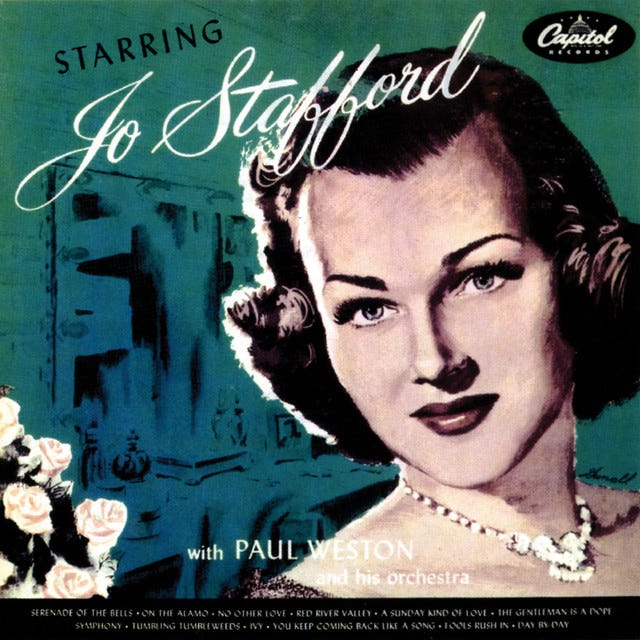
What is perfect pitch? Jo Stafford was said to have it, though she modestly said that she really had “good relative pitch.” Listen to her sing and she has a way of hitting a note straight in its center so that the effect is one of shimmering, aspirational perfection, ghostly, haunting, almost icy, but with a sort of earthiness underneath, a highly unusual blend.
Great singers like Billie Holiday and Patsy Cline doted on Stafford and her sound, and Holiday often mentioned in interviews how much she admired Stafford’s voice because it sounded like a musical instrument. Tough-talking jazz great Annie Ross said that Stafford “never hit a bum note” in her working life as a singer, though she did have a comedy sideline with her musician husband Paul Weston where they pretended to be the world’s worst lounge act, a pair of musical unfortunates named Jonathan and Darlene Edwards.
You would think that singing off-key as a comedy act would wear thin pretty quickly, but Stafford’s bum notes as Darlene are ever-renewingly hilarious, some of the worst possible singing to go with her catalogue of some of the best singing of its time. (Another famous Stafford fan: Lucille Ball couldn’t get enough of the Jonathan and Darlene Edwards act when Stafford and Weston would do it at Hollywood parties and thought it one of the funniest things she had ever seen.)
Stafford started out in a singing group with her sisters, and then she was part of a group called the Pied Pipers, which sang with the Tommy Dorsey band and backed the Frank Sinatra hit “I’ll Never Smile Again.” The turning point for Stafford was her decision to sing a collection of folk songs for the 1948 album Jo Stafford Sings American Folk Songs, a record that influenced the nascent folk music scene and particularly Judy Collins, who loved it as a child. Stafford’s singing is at its most otherworldly on songs like “Shenandoah” and “Barbara Allen,” and she isn’t afraid to mix these with more up-tempo numbers for variety.
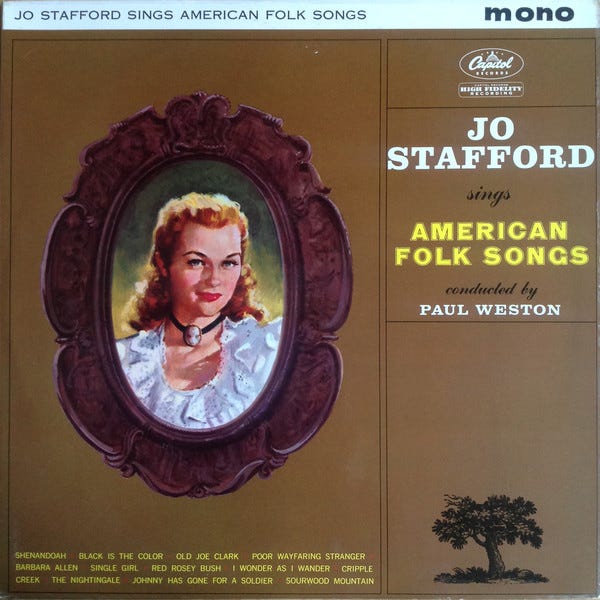
Stafford had a wide range as a singer, but her best work is generally in the realm of story songs and sacred music, especially when she sang it with Gordon MacRae for their duet albums. She was very much a recording star; she didn’t like singing live. Give her a recording studio and some beautiful Weston arrangements and Stafford would hit one home run after another. The only thing she can’t really do are songs in a cynical/heartless vein; I don’t really want to listen to her do Cole Porter songs from Kiss Me, Kate or something like “Diamonds Are a Girl’s Best Friend.” Her forte is what could be termed parlor songs, songs like “Drink to Me Only with Thine Eyes” or “Flow Gently, Sweet Afton.” And she really soars with a ballad like “Through the Years,” which lands precisely because of her reserve, her ultra-fast vibrato that is barely a vibrato at all, her ministering quality.
I first became aware of Stafford after reading the Mary Gaitskill novel Veronica (2005), which contains a section where Gaitskill writes about how men who served in World War II had a special place in their heart for Stafford, who entertained the troops so much that she was known as GI Jo. These men listened to her albums in the immediate post-war period of prosperity, and I think Stafford had such a meaning to them because her voice has healing qualities. She knows they have been through hell, and she gently lifts them out of it; you can almost feel yourself detaching from the worst of life and floating away from it when you listen to her voice.
I must have heard Stafford’s biggest hit song “You Belong to Me” (1952) at some earlier point, but it was only when I heard it in Terence Davies’s movie The Deep Blue Sea (2011) that I started seeking out Stafford’s albums. Once I got her folk music album and Songs of Scotland (1955), I listened to them over and over again, as if her voice might lift me up and enrich me, make me better, happier, more whole. And I believe it did so. I can remember years like 2015 and 2016 when I would play Jo Stafford records like Autumn in New York (1950) and Starring Jo Stafford (1953) while having dinner with my longtime sweetheart Keith Uhlich in the dining room of our house in Park Slope, Brooklyn, and thinking, “It does not get better than this….being here with Keith and eating the food he cooked and listening to the voice of Jo Stafford.”
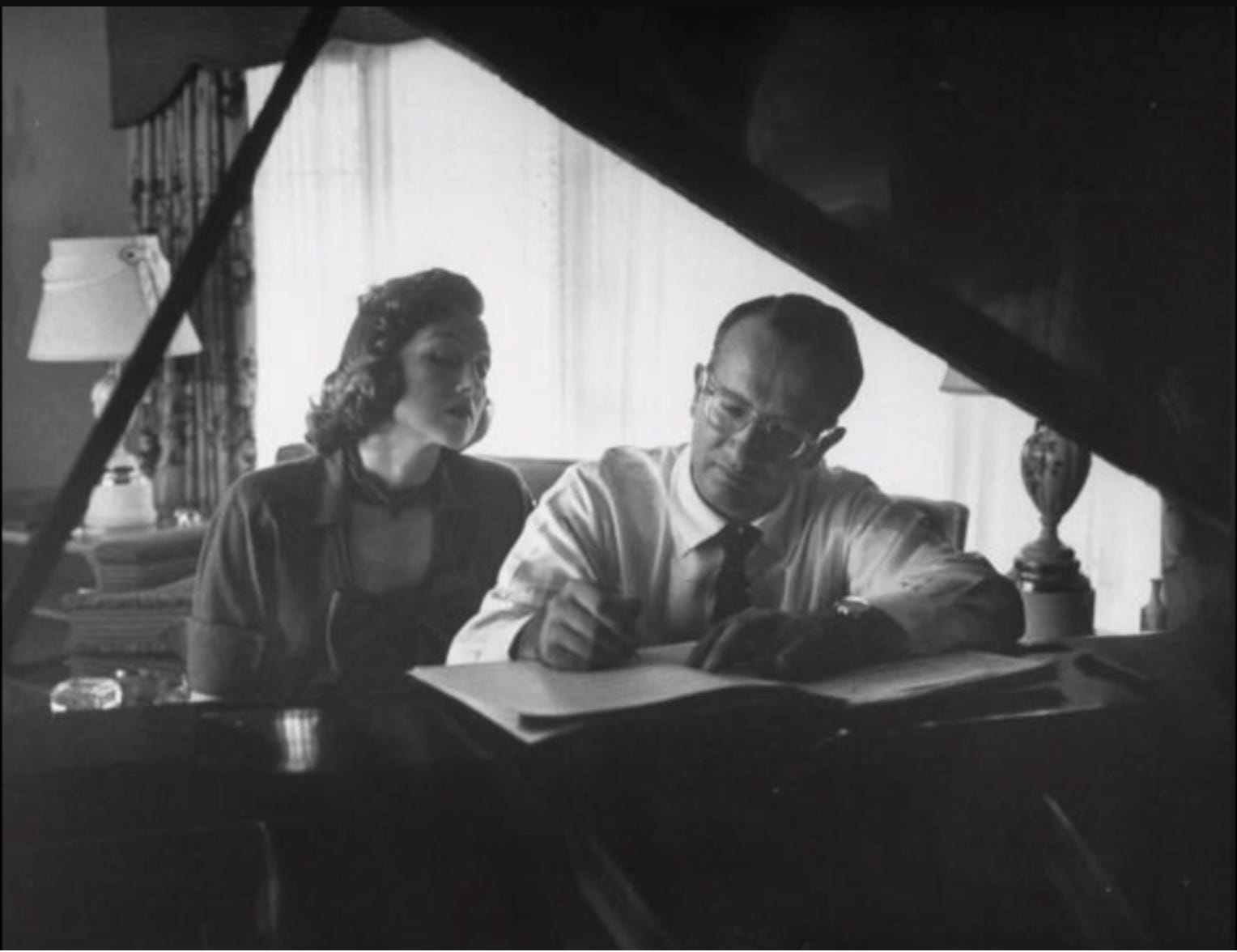
Listen to her sing songs like “Tumbling Tumbleweeds” and “Red River Valley” on Starring Jo Stafford and hear how much she can do to both honor and ameliorate their poetic melancholy. What is it about her voice that moves me so much? I think it has something to do with how private she seems, as if she is leading you discreetly into some secret place in order to give you something she finds precious, out of the goodness of her heart. There is a creative tension between what sounds like personal reticence and something more low-down, something passionate that she has to keep under some restraints so that it doesn’t overwhelm her, or us. Below is a photo of Stafford with her husband Paul, a singer’s singer with a musician’s musician.
Stafford knew when to stop; by the mid-1960s, her voice wasn’t quite up to her own standard anymore, and so she retired, only coming back once to sing for a tribute to Frank Sinatra in 1990. (But she did let her bad singer alter ego Darlene Edwards cluelessly continue on and even had her do a cover of the Bee Gees’s “Stayin’ Alive.”) She lived until the age of 90, and her voice is still there, immaculate and tender, on her records. Stafford has become one of my very favorite singers, a singer I return to over and over again, in times of trouble, in times of great happiness, she is there. You can listen to some of her music on Spotify, where you can find her folk music album and several others I’ve mentioned.
Below is one of her best late albums, I’ll Be Seeing You (1959), a tribute to the soldiers she had loved and inspired and given such solace to. Stafford is so American in that she approaches perfection, and yet she makes that perfection seem attainable. She offers us a balm, a benediction; it’s as if she wants to protect us all with her voice. I’ve never encountered anything else like it.
Many of her albums can be purchased through the website Corinthian Records, which was Stafford’s own company, through which she sold the music that she owned in her later years. Here is a link:
https://www.corinthianrecordsonline.com/store
I was told by a choral teacher that KU has perfect pitch. :-)
🥰