
Nat Pendleton
Palooka

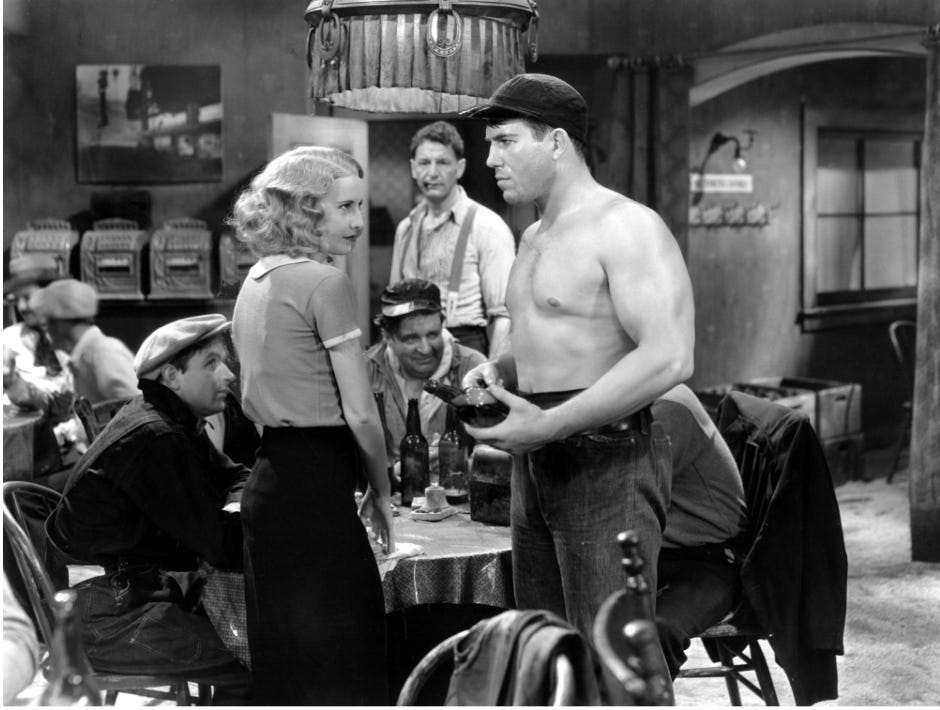
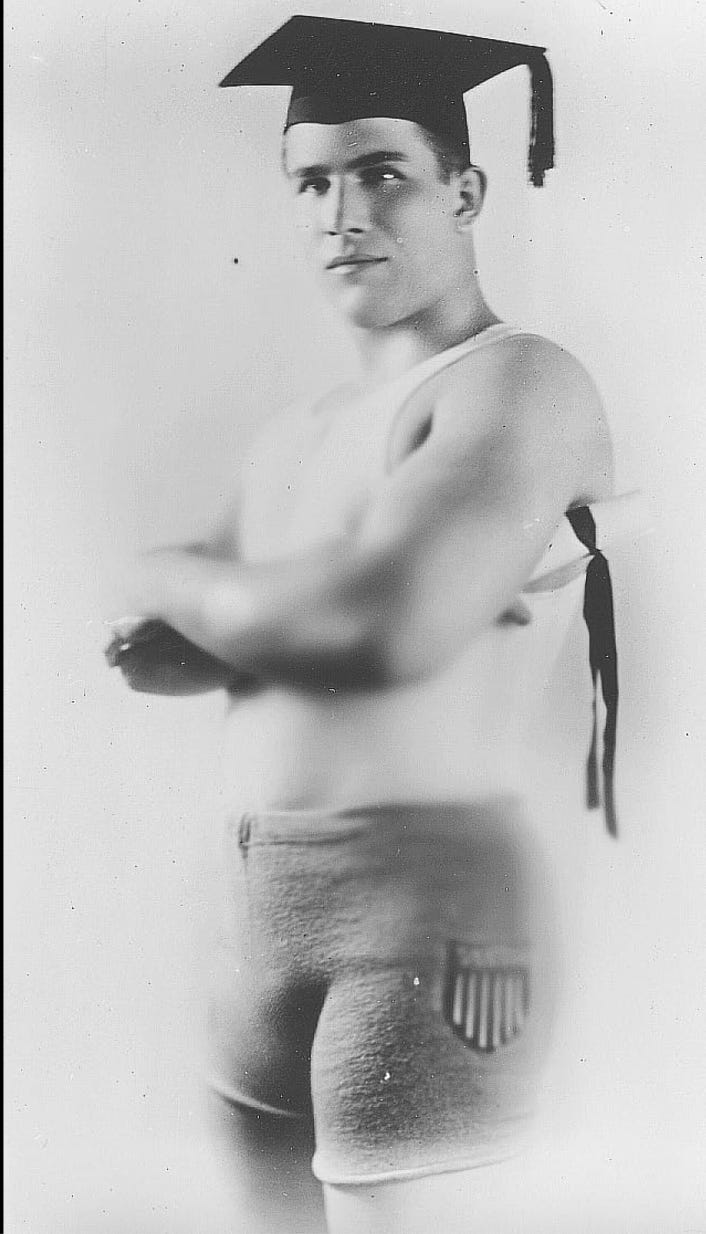
Most of Nat Pendleton’s 113 credits come from his regular appearances in 1930s movies as slow-witted cops, football players, bouncers, gangsters, and gangster sidekicks, and the muscular body that made him a wrestling champion at Columbia University, where he received a degree in economics, and an Olympic silver medal winner in 1920, was often covered up. Pendleton spoke several languages, and he was an avid reader and chess player, but in movies he was invariably a dumb palooka, often menacing in character or officious, but too dopey to be any kind of serious threat.
After creating and then selling a successful import/export business and then working for General Motors, Pendleton took a bit role as a barber in Rudolph Valentino’s costume picture Monsieur Beaucaire (1924) and made his sound debut in The Laughing Lady (1929), a Ruth Chatterton vehicle in which he is a lifeguard who saves Chatterton’s life and then gets drunk and breaks into her room hoping for sex.
Pendleton did a light Irish accent for his small role in The Big Pond (1930), and after various minor parts he menaced Harpo Marx in Horse Feathers (1932) until Harpo took a finger of Pendleton’s big hand and put it on a hot dog bun and bit into it. In Cecil B. DeMille’s epic The Sign of the Cross (1932), Pendleton was a lug named Strabo who rounds up Christians for money.
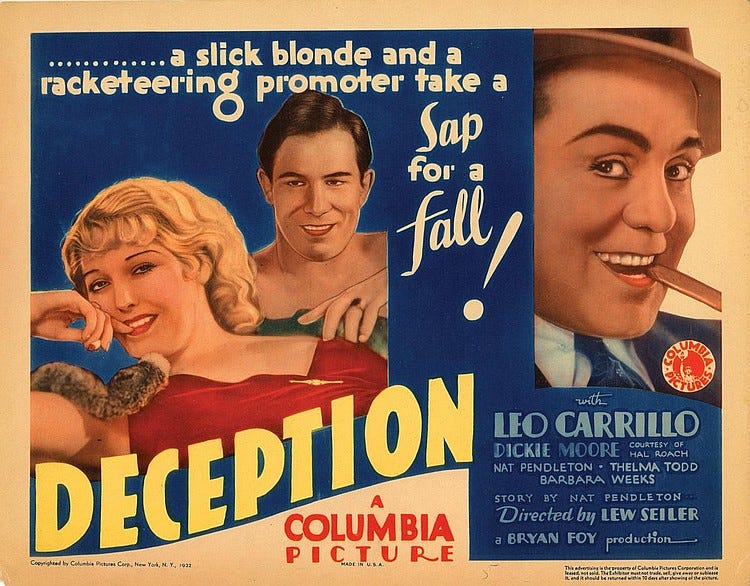
But that same year Pendleton wrote the script for a starring vehicle for himself, Deception (1932), which was shot at Columbia and hasn’t been seen or heard much since. From the description of the plot, it sounds like Pendleton used some of his knowledge of how crooked professional wrestling could be, and presumably he wrote himself a more sympathetic character than he generally played.
Pendleton’s best year in pictures was 1933, when he got his finest mainstream role as a softhearted gangster named Tony Gazotti in W.S. Van Dyke’s Penthouse (1933). Pendleton’s Gazotti is tickled by the tough talk of his own lawyer (Warner Baxter), and he has a very human moment in the backseat of a cab with him where he speaks of school and wonders plaintively, “What’s algebra?” Van Dyke is very much showcasing Myrna Loy in this movie, but he provides a smaller showcase for Pendleton, even giving him a somewhat noble death scene. This is one of the rare movies Pendleton made where his character was given some shading.
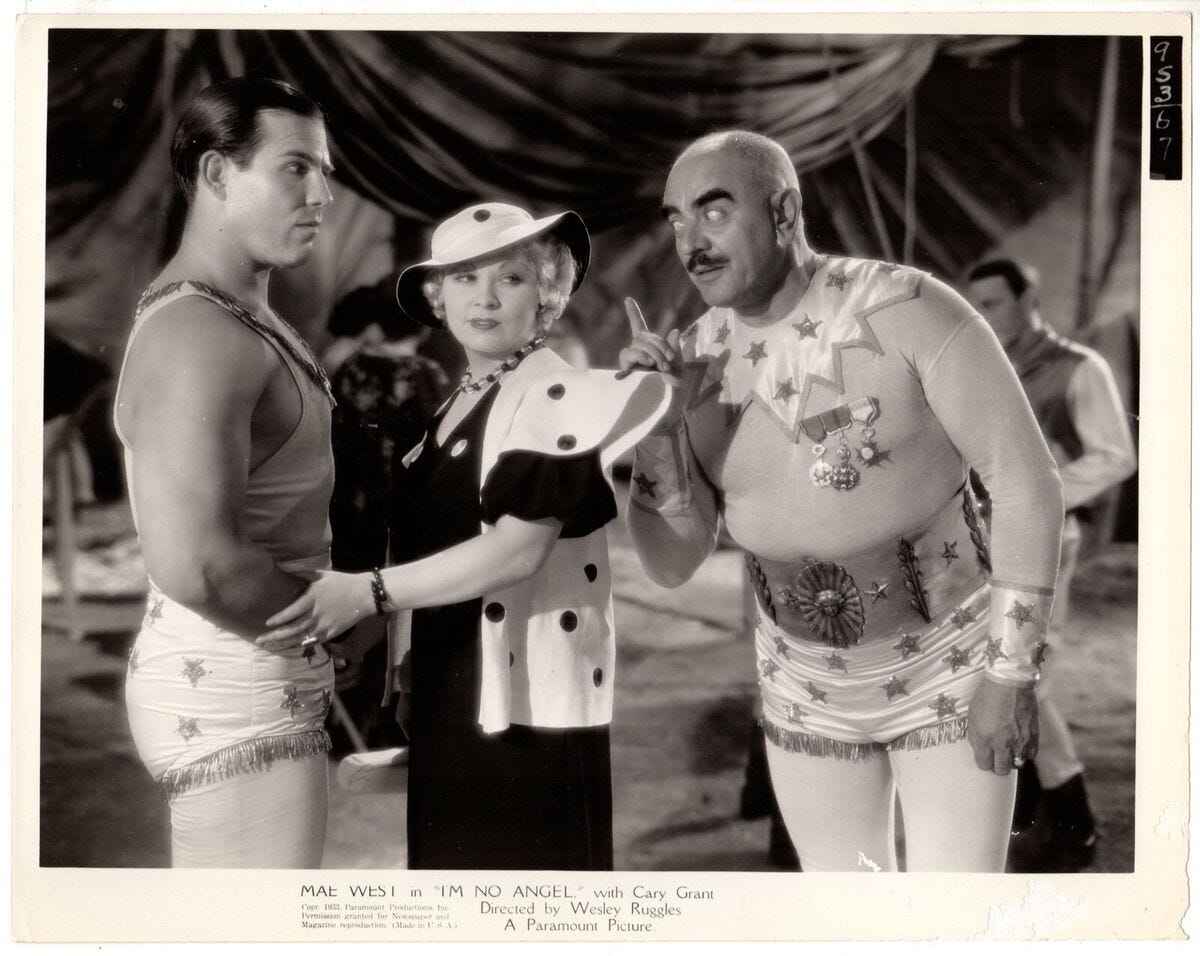
Pendleton was a hunky laborer with his shirt off in the opening scenes of Baby Face (1933), where he wants to go take “a walk by the quarry” with Barbara Stanwyck’s Lily, who reacts to this very good-looking guy in an ambiguous way, as if she did go for a “walk” with him at some point and might even have enjoyed it, but she’s too fed up for another round. Best of all, Pendleton played an acrobat with a yen for Mae West in I’m No Angel (1933) where West, who was noted for her love of muscle men, feels Pendleton’s arm and torso in a tender yet slightly contemptuous way. Only someone as modern as West was going to view Pendleton as a sex object in this era.
In the epic The Great Ziegfeld (1936), which won a best picture Oscar, Pendleton does a German accent and wears a blond curly wig to play Sandow, a strongman who is sold to the public by showman Florenz Ziegfeld (William Powell) for his “sex appeal” to mainly older women, who line up to feel his muscles, and this is viewed by the movie itself as vaguely distasteful. In this same period, Pendleton turned up in The Thin Man (1934) and the third movie in the series Another Thin Man (1939) as a dim-bulb cop who very much needs the help of Powell’s Nick Charles and Myrna Loy’s Nora Charles to solve a case.
Pendleton wound up in an ongoing part as an ambulance driver in the Dr. Kildare movies at MGM, and his career petered out in the 1940s; he died in 1967 at the age of 72. In retrospect, it feels like Pendleton was cast the way he was, and often played his roles the way he did, in order to make himself less attractive, as if his good looks were a kind of threat. Surely he could have played a more appealing hunky lead; imagine him doing the part that Max Baer got to do opposite Myrna Loy in The Prizefighter and the Lady (1933) at MGM. If he stood still, Pendleton was beautiful, but when animated he was trained to make himself almost ugly in his reactions on screen, alas.
Always enjoy seeing Nat Pendleton on my screen!
Excellent tribute. I keep forgetting he was an Olympian and A Columbia Grad. He was a good actor